Stratford-upon-Avon
13 The Courtyard
Timothy's Bridge Road
Stratford-Upon-Avon
Warwickshire CV37 9NP


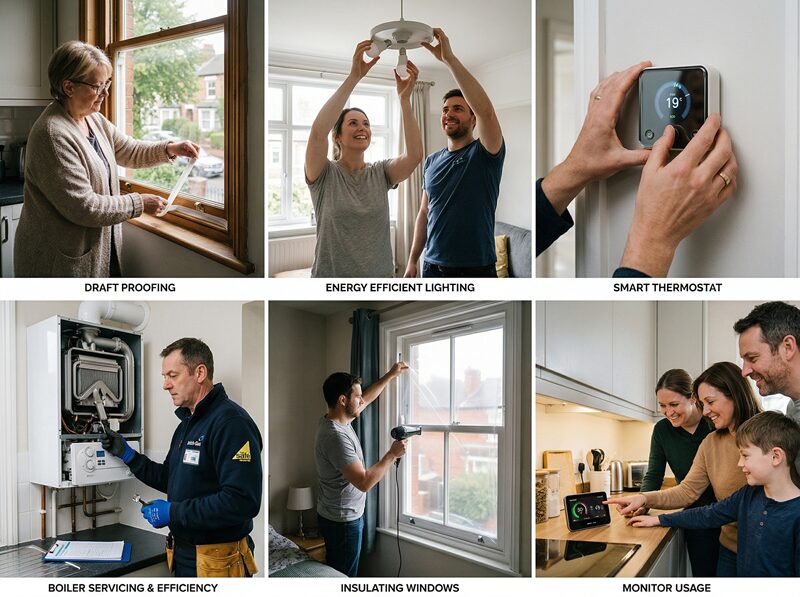
Energy costs remain a significant pressure on household budgets, and reducing consumption continues to be one of the most reliable ways to control expenditure. Fortunately, many practical steps can lower usage without reducing comfort. A structured approach often produces the best results, starting with quick wins and then considering longer term improvements.
Heating is usually the largest component of domestic energy use, often accounting for more than half of total consumption. Ensuring that boilers are serviced regularly helps maintain efficiency and can prevent higher fuel usage caused by poorly operating equipment. Reducing thermostat settings by just one degree can cut heating bills noticeably over a full year. Installing a programmable thermostat allows heating to operate only when needed, avoiding unnecessary energy use during the night or when the home is unoccupied.
Improving insulation is one of the most effective long term strategies. Loft insulation reduces heat loss through the roof, while cavity wall insulation helps retain warmth inside the property. Draught proofing around doors and windows is inexpensive and can produce immediate benefits. Even simple measures such as closing curtains at dusk help retain heat during colder months.
Electricity consumption can also be reduced through small behavioural changes. Switching off appliances rather than leaving them on standby can reduce wasted electricity. Many modern devices continue to consume power even when not in active use. Using energy efficient LED lighting instead of traditional bulbs reduces electricity consumption significantly and LED bulbs also last much longer, reducing replacement costs.
Households should also consider how hot water is used. Lowering the temperature setting on a boiler or hot water cylinder can reduce energy use without affecting comfort. Installing water efficient shower heads and avoiding unnecessarily long showers can also contribute to meaningful savings over time. Washing clothes at lower temperatures and ensuring washing machines are fully loaded before use can further reduce electricity and water usage.
For households able to consider capital investment, energy efficient appliances, improved glazing, solar panels or battery storage may offer longer term savings. While these measures involve upfront cost, they can reduce ongoing energy expenditure and may increase property value.
Taking a planned approach to reducing energy consumption can produce steady financial savings and may also reduce exposure to future increases in fuel prices. Even modest adjustments, when combined, can produce noticeable reductions in household energy costs over the course of a year.
Grenfell James Technology Adoption Index
How does your business perform against others adopting financial tech? Find out with our interactive diagnostic:
1.
How does your business receive invoices?
A)
Invoices are mainly received in paper form
B)
Invoices are mainly received by email
C)
Invoices are emailed then automatically forwarded to a designated mailbox
2.
How are purchase invoices processed?
A)
Invoices are entered manually
B)
Invoices are attached to manually raised invoices
C)
Automated software (e.g. ReceiptBank, 1Tap, HubDoc etc) collates invoices
3.
How are accounts processed?
A)
Using Excel/paper-based
B)
Using Computer-based, offline software
C)
Using cloud-based accountancy software
4.
How often is business data revised?
A)
Data is updated annually
B)
Data is updated quarterly
C)
Data is updated monthly or more often
5.
How is banking updated for your business?
A)
Banking is updated manually
B)
Banking is updated by imports
C)
Banking is updated via a live feed
6.
How are bank payments made?
A)
Bank payments are manual
B)
Bank payments are made using bulk imports
C)
Bank payments are made directly via accounting software
7.
How are bank receipts reconciled?
A)
Receipts are chased and reconciled manually
B)
Receipts are chased and reconciled automatically
C)
A third-party platform is used to chase debts and collect fees
8.
How often are management reports produced?
A)
No reports are provided
B)
Reports are provided but often too late to be valuable
C)
Reports are automated with real-time information
Score 8-12:
Curious Exploration
Your financial technology phase is Curious Exploration
% of respondent businesses are in this phase too.
Switching accountancy systems may seem like an upheaval, but can be much more straightforward than most businesses imagine. From talking to our clients, they have found moving from paper invoicing and desktop-based accounting software to the cloud and apps quickly makes the transition process a worthwhile investment of time. Digital accounting solutions bring in streamlined processes, up-to-date business data and greater confidence in the accuracy of information when making financial decisions.
Grenfell James works with your team to fully assess the needs of your business and minimise the impact of any transitions for solutions we recommend.
Score 13-19:
Measured Discovery
Your financial technology phase is Measured Discovery
% of respondent businesses are in this phase too.
Once cloud accountancy software is in place, there’s still plenty of scope to improve your accountancy processes and make sure your business is maximising the benefits of adopting a digital accounting solution. Grenfell James assesses each business to understand how any implemented solutions are being used, identify areas for improvement and the needs of the business overall to support your business goals and achieve success.
Our team of experts can discuss a range of time-saving automation and get different apps and cloud-based solutions talking to create and manage a digital accountancy eco-system to help your business grow.
Score 20-24:
Bold Innovation
Your financial technology phase is Bold Innovation
% of respondent businesses are in this phase too.
You know the benefits of accounting technology and the impact it can have on your business goals. If you want to take it a step further, our team can conduct a systematic review of your processes, apps and business goals to ensure your digital accountancy ecosystem is keeping pace with the changing needs of a growing business.