Stratford-upon-Avon
13 The Courtyard
Timothy's Bridge Road
Stratford-Upon-Avon
Warwickshire CV37 9NP


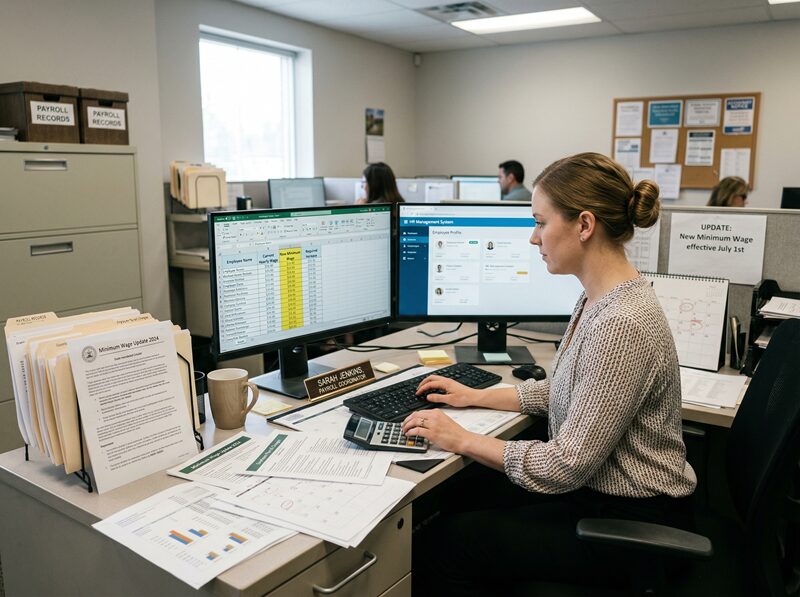
From April 2026, the National Minimum Wage and National Living Wage rates have increased, and businesses should ensure payroll systems are updated immediately so that employees receive the correct statutory pay. These changes apply from the start of the 2026-27 tax year and form part of the Government’s ongoing policy of maintaining minimum earnings levels that reflect wider wage growth and living cost pressures.
The key rates from 1 April 2026 are as follows:
- Age 21 and over (National Living Wage): £12.71 per hour
- Age 18 to 20: £10.85 per hour
- Age 16 to 17: £8.00 per hour
- Apprentice rate: £8.00 per hour
These increases mean many employers will see a rise in employment costs during 2026-27, particularly where businesses rely on part-time staff, seasonal workers, or apprentices. Around 2.7 million workers are expected to benefit from the increase, reinforcing the importance of ensuring compliance from the first pay period after 1 April 2026.
For employers, the immediate priority is to review payroll settings, salary sacrifice arrangements, and employment contracts to confirm that hourly pay levels meet or exceed the new statutory thresholds. Failure to apply the correct rates can result in penalties and reputational risk, as HMRC has powers to require repayment of arrears and to publicly identify employers who do not comply with minimum wage legislation.
It is also important to consider knock-on effects. Businesses paying slightly above the previous minimum wage may wish to review pay differentials across their workforce in order to maintain fairness and staff morale. In practice, increases in the statutory minimum often lead to wider wage adjustments as employers maintain distinctions between entry-level and more experienced roles.
Grenfell James Technology Adoption Index
How does your business perform against others adopting financial tech? Find out with our interactive diagnostic:
1.
How does your business receive invoices?
A)
Invoices are mainly received in paper form
B)
Invoices are mainly received by email
C)
Invoices are emailed then automatically forwarded to a designated mailbox
2.
How are purchase invoices processed?
A)
Invoices are entered manually
B)
Invoices are attached to manually raised invoices
C)
Automated software (e.g. ReceiptBank, 1Tap, HubDoc etc) collates invoices
3.
How are accounts processed?
A)
Using Excel/paper-based
B)
Using Computer-based, offline software
C)
Using cloud-based accountancy software
4.
How often is business data revised?
A)
Data is updated annually
B)
Data is updated quarterly
C)
Data is updated monthly or more often
5.
How is banking updated for your business?
A)
Banking is updated manually
B)
Banking is updated by imports
C)
Banking is updated via a live feed
6.
How are bank payments made?
A)
Bank payments are manual
B)
Bank payments are made using bulk imports
C)
Bank payments are made directly via accounting software
7.
How are bank receipts reconciled?
A)
Receipts are chased and reconciled manually
B)
Receipts are chased and reconciled automatically
C)
A third-party platform is used to chase debts and collect fees
8.
How often are management reports produced?
A)
No reports are provided
B)
Reports are provided but often too late to be valuable
C)
Reports are automated with real-time information
Score 8-12:
Curious Exploration
Your financial technology phase is Curious Exploration
% of respondent businesses are in this phase too.
Switching accountancy systems may seem like an upheaval, but can be much more straightforward than most businesses imagine. From talking to our clients, they have found moving from paper invoicing and desktop-based accounting software to the cloud and apps quickly makes the transition process a worthwhile investment of time. Digital accounting solutions bring in streamlined processes, up-to-date business data and greater confidence in the accuracy of information when making financial decisions.
Grenfell James works with your team to fully assess the needs of your business and minimise the impact of any transitions for solutions we recommend.
Score 13-19:
Measured Discovery
Your financial technology phase is Measured Discovery
% of respondent businesses are in this phase too.
Once cloud accountancy software is in place, there’s still plenty of scope to improve your accountancy processes and make sure your business is maximising the benefits of adopting a digital accounting solution. Grenfell James assesses each business to understand how any implemented solutions are being used, identify areas for improvement and the needs of the business overall to support your business goals and achieve success.
Our team of experts can discuss a range of time-saving automation and get different apps and cloud-based solutions talking to create and manage a digital accountancy eco-system to help your business grow.
Score 20-24:
Bold Innovation
Your financial technology phase is Bold Innovation
% of respondent businesses are in this phase too.
You know the benefits of accounting technology and the impact it can have on your business goals. If you want to take it a step further, our team can conduct a systematic review of your processes, apps and business goals to ensure your digital accountancy ecosystem is keeping pace with the changing needs of a growing business.